Speed reading techniques that actually work

Four techniques hold up under measurement: pacing yourself with an external timer or moving target, cutting regressions, reducing subvocalization on easy material, and previewing a text before reading it properly. Three popular ones do not: reading in a zigzag down the page, training peripheral vision to take in whole lines, and any programme promising 1,000 words per minute with full understanding. The difference matters, because the working techniques give you a genuine 1.5x to 2x on ordinary prose and the rest give you the feeling of speed while comprehension quietly drops.
Build a reading pace that holds, step by step
- Preview before you read. Spend 30 seconds on the headings, the first line of each section and any charts. Knowing the shape of an argument lets you read the body faster because you are confirming rather than discovering.
- Use an external pacer. A finger under the line, a moving highlight, or a word stream at a set WPM. Any of them stops you from drifting back to your default pace, which is the technique doing the actual work.
- Cut the reflex regressions. Resist re-reading a phrase unless you genuinely lost the meaning. A stream that does not show you the previous line makes this automatic rather than a matter of willpower.
- Let the inner voice fall behind. Set a pace slightly above talking speed, around 300 WPM, and stay there until pronouncing every word becomes impossible. Do not try to suppress it directly; that just adds effort.
- Vary the pace by material. Push blogs and news, hold the middle for books, and drop to normal reading for anything technical. One speed for everything is how comprehension gets lost.
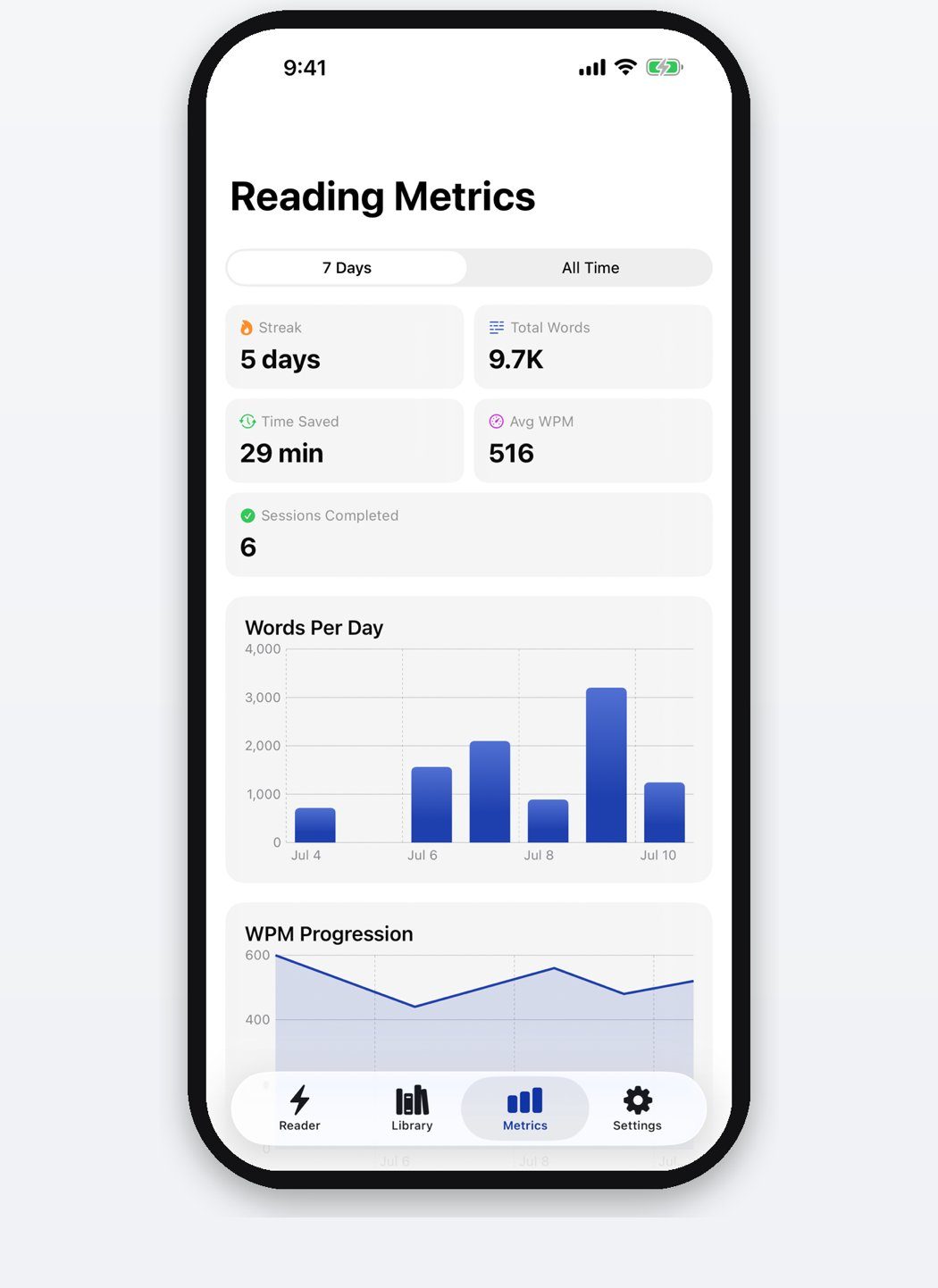
- Track the number. Words read, average WPM and session count tell you whether the training is working. Two weeks of data beats any impression of getting faster.
The techniques with evidence behind them
Pacing is the oldest and the most reliable. Whether the pacer is a finger under the line or a word stream at 400 WPM, an external rhythm stops you settling back to habit speed. Most of the improvement people attribute to a speed reading course comes from this one mechanism.
Cutting regressions is the second. Adult readers glance backwards on roughly 10 to 15 percent of fixations, and studies that block regressions find comprehension usually survives, because most of them were habit rather than repair. This is where serial presentation has an unfair advantage: the previous line is not on the screen, so the habit has nothing to act on.
Reducing subvocalization is the third, with a caveat. On familiar, straightforward prose, letting the inner voice fall behind is fine and raises the ceiling above talking speed. On difficult material the inner voice appears to help hold sentences together while you work them out, so suppressing it there costs you understanding rather than saving time.
Previewing is the fourth and the most undersold. Half a minute on the structure of a report before you read it makes the reading itself faster, because you are slotting details into a frame you already have instead of building the frame as you go.
The techniques that do not survive testing
Skimming in a Z or S pattern down the page is not reading; it is sampling, and it works only when you already know most of the content and want to confirm one fact. Taught as a general method it produces confident readers who cannot answer questions about the middle third of the article.
Widening peripheral vision to take in an entire line at once fails on the physiology. The fovea, the sharp part of your retina, covers about two degrees of your visual field, which is roughly eight to ten characters at normal reading distance. Everything outside that is too blurry to identify words in, and no amount of training changes the anatomy.
Programmes promising 1,000 WPM with full comprehension have been examined for decades and the results are consistent. When speed goes far past 500, understanding drops in proportion. Some famously fast readers turn out to have extremely wide background knowledge in the subject, which is a different skill.
Putting the working four together
A practical session looks like this. Preview the piece for half a minute. Start the stream 25 WPM above wherever you were comfortable last time, with a short warm-up ramp so the first few seconds are not a shock. Read straight through, scrubbing back only where a sentence genuinely fell apart. At the end, say the argument out loud in two sentences.
Do that daily for ten minutes and the number climbs on its own. The reason to track it is not the score; it is that reading speed drops when you are tired or when the material is harder than you expected, and seeing the average fall is a better signal than a vague sense that this week was slow.
Questions
Do speed reading courses work at all?
The pacing and previewing they teach do work, and those are the parts you can copy for free. The claims about peripheral word intake and four-figure reading speeds are the parts that do not hold up when comprehension is measured.
Is it better to train on easy or hard material?
Easy and familiar, at least at first. Pushing pace on unfamiliar technical writing teaches you to skip rather than to read faster, and the resulting number is not one you can carry back to normal material.