How to read faster without losing comprehension

Most adults read ordinary prose at roughly 250 words per minute, and most can get to 400 or 450 with practice and the right tool. Beyond about 500 WPM you are skimming, and reading researchers have measured the comprehension cost repeatedly. The gains available below that ceiling are real and mechanical: cut the time your eyes spend jumping between words, stop re-reading lines you already understood, and quiet the inner voice that paces you at talking speed.
Raise your reading speed without losing the thread, step by step
- Measure your real baseline. Read a full article at your natural pace and note the words per minute. Guessing produces a number 100 WPM too high. SpeedyReader logs the figure for every session so the baseline is measured rather than remembered.
- Move up in small steps. Add 25 to 50 WPM, not 200. A jump that feels comfortable after two paragraphs is the right size; a jump that turns the text into a blur is training nothing.
- Check yourself after every session. Close the app and say out loud what the piece argued and one detail that supported it. If you can do that, the new pace held. If you cannot, drop back 50.
- Hold the new pace for three sessions. Speed gains stick when they are boring. Three sessions at 350 before trying 400 beats one heroic run at 600 that teaches your brain to skip.
- Match the pace to the material. News and blog posts take the top of your range. Contracts, textbooks and anything with equations take the bottom, or your normal page reading.
- Read every day, briefly. Ten minutes daily moves the number faster than an hour on Sunday. The streak counter in the app exists for exactly this reason.
What actually limits your reading speed
Three mechanics set the ceiling. The first is saccades, the small jerky jumps your eyes make from one fixation to the next. Your eyes are effectively blind during the jump itself, and across a page those jumps eat somewhere around 10 to 15 percent of reading time. The second is regression, the backward glance to a phrase you already passed. Eye-tracking studies put regressions at roughly 10 to 15 percent of fixations for adult readers, and many of them are habit rather than genuine confusion. The third is subvocalization, the inner voice that pronounces each word. Speech runs at about 150 to 200 words per minute, and a reader who pronounces everything internally is anchored near that speed.
Notice what is not on that list: how quickly your brain recognizes a word. Word recognition itself takes well under 100 milliseconds for common vocabulary. The bottleneck is delivery, not processing, which is why removing the delivery costs produces a genuine gain rather than a trick.
The 400 to 500 WPM window is where the honest gains live
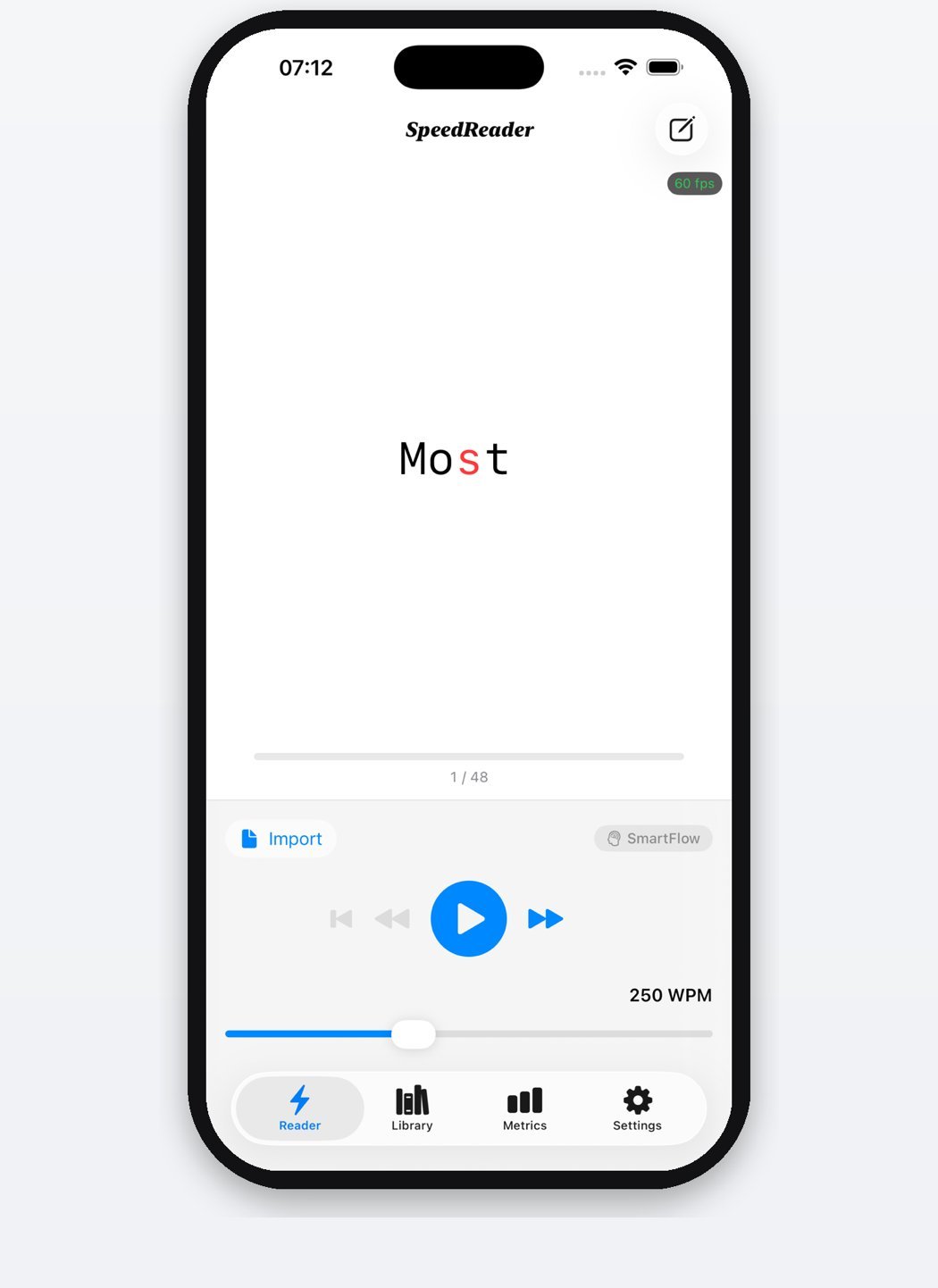
Serial word presentation removes saccades outright by putting every word in the same place, and it removes casual regressions by not offering the previous line to glance back at. That is two of the three costs gone without asking you to change anything about how you think. Subvocalization thins out on its own at higher speeds, because the inner voice cannot keep up and eventually stops trying.
What this does not buy you is the 1,000 WPM figure that speed-reading courses have sold since the 1960s. Keith Rayner’s 2016 review of the evidence was blunt about it: there is no method that lets you read at those rates and still understand what you read. Comprehension holds up well at moderate speeds and then falls off a cliff. Treat 400 to 500 as the target and you get a real doubling of throughput on articles, reports and email. Treat 900 as the target and you get the feeling of reading without the substance.
Comprehension checks that take ten seconds
Speed without a check is guesswork. After each session, do one of these: summarize the piece in two sentences, name the strongest objection the author answered, or write down a single number or date the article used. Any of them is enough to catch the failure mode, which is finishing a text feeling informed while retaining nothing.
If the check fails at 450 but passes at 400, you have found your current edge, and the number will move over a few weeks. It moves faster on familiar material. Reading a topic you already know lets you push the pace because your background knowledge fills gaps; reading a new field at the same pace produces the illusion of understanding.
When slowing down is the correct move
Some text resists speed by design. Legal language, technical specifications, poetry, and anything where a single qualifying clause changes the meaning all reward slow, deliberate reading with re-reads. So does anything you intend to argue about later. The point of building speed is not to apply it everywhere. It is to clear the 40 saved articles and the weekly report backlog quickly enough that you have time left for the material that deserves attention.
A practical split: run news, newsletters, blog posts and long email threads at the top of your range, run books at the middle, and read the hard 10 percent the old way, on the page, with a pencil.
Questions
Does reading faster reduce how much I remember a week later?
At moderate speeds the difference is small for straightforward material, and daily reading volume matters more for retention than pace. Recall does suffer when you push past roughly 500 WPM, and it suffers most on dense or unfamiliar topics.
How long does it take to get from 250 to 400 WPM?
Two to four weeks of ten minutes a day is typical, with most of the jump arriving in the first week as the inner voice stops pacing you. Progress after 500 is slow and usually not worth chasing.