What is music scrobbling?
Scrobbling is the automatic logging of every track you play, sent from your player to a service that keeps the record. The word comes from Audioscrobbler, the 2002 project that became Last.fm, and it stuck because no better word appeared. A scrobbler answers questions your streaming app cannot: what you played on this exact date three years ago, how many times you have heard one song, and how your taste has shifted month by month. The trade is that you have to connect an account and let something keep the log.
Where the word came from
Audioscrobbler started as a university project by Richard Jones in 2002: a plugin that reported what you were playing to a central database, plus a recommendation engine built on the resulting data. It merged with Last.fm in 2005, and the verb "to scrobble" came with it. Two decades later the term is still in use because the concept has no plainer name. Logging is too vague, tracking sounds like surveillance, and history is what the streaming apps call their own limited version.
Last.fm remains the best-known destination, with ListenBrainz as the open, non-commercial alternative and Libre.fm as the free software option. Around them sits a small ecosystem of scrobbler clients: Pano Scrobbler on Android, Marvis Pro as an Apple Music front end, and self-hosted projects like Maloja and Koito for people who want the database on their own machine.
What a scrobble record is good for
Play counts are the obvious payoff. Once a few thousand scrobbles have accumulated, the question "what is my most-played song" has an actual answer instead of a guess. Beyond counts, a scrobble log gives you dated history, so an evening in November 2023 has a soundtrack you can look up, and it gives you comparison over time: this month against last, this year against the one before.
The social half matters as much as the archival half. Last.fm built its reputation on taste compatibility between users and on recommendations drawn from what people like you actually played rather than what a label wanted promoted. Any modern alternative that skips the social layer keeps the spreadsheet and loses the reason people came.
Modern alternatives to Last.fm scrobbling
Most people searching for a Last.fm alternative want one of three things. Some want an open database they control, which points to ListenBrainz or a self-hosted Maloja instance. Some want a better phone client, since Last.fm’s own apps have aged. And some want the part Last.fm was always weakest at on mobile: seeing friends’ listening as it happens, reacting to it, and having a conversation about it.
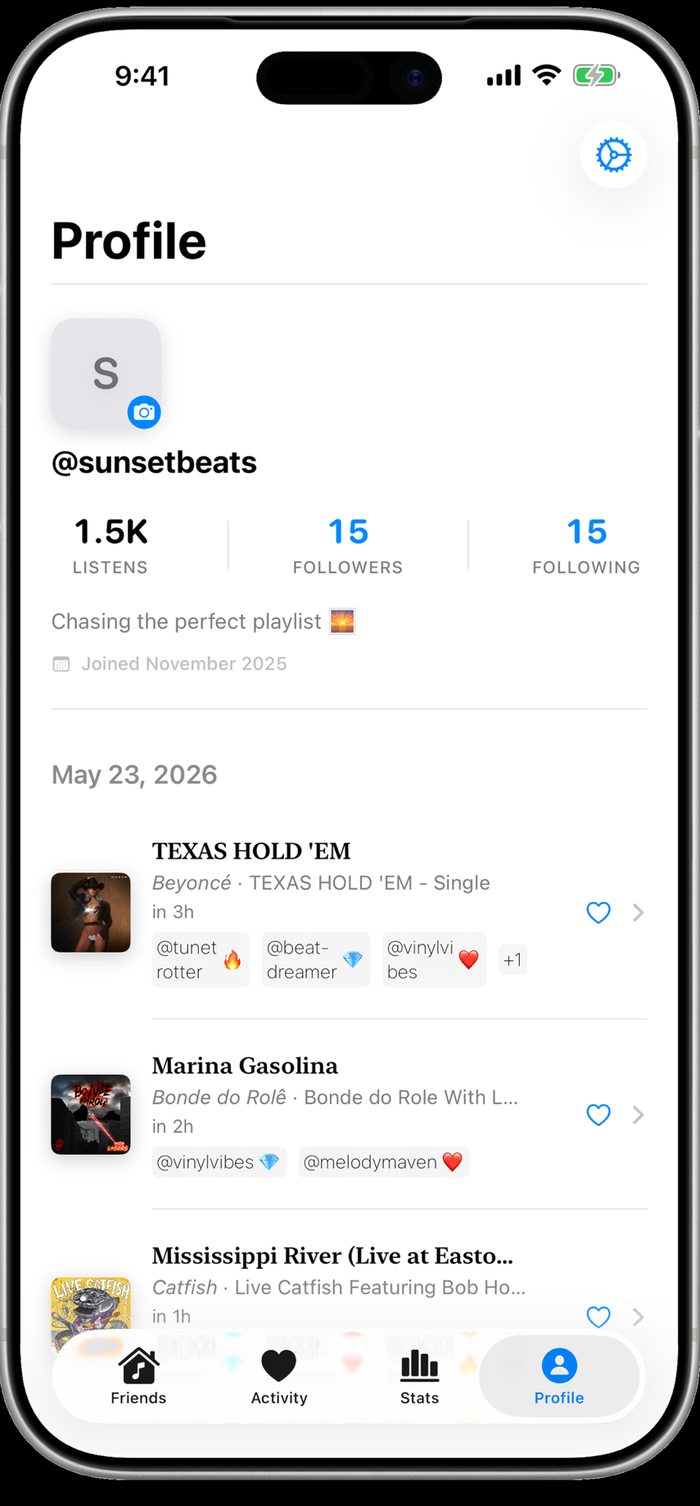
Soundbooth is built for that third group. Connect Apple Music or Spotify, and it keeps the log for you: every listen with its timestamp, plus the artist, album and track metadata pulled from Apple Music. Your profile shows your listen history grouped by date, along with total listens, followers, and following. It is a scrobble log with a feed attached, rather than a database with a website attached.
How scrobbling works technically
Classic scrobbling ran client-side: a plugin inside Winamp or iTunes watched playback and posted a scrobble once you passed roughly half the track. Streaming changed the plumbing. Apple Music and Spotify both expose a recently-played endpoint, so modern apps ask the service what you played rather than watching your speakers.
That design has one visible consequence. Polling happens on a schedule, so a listen appears after a delay instead of the instant the song starts. It also has an invisible advantage: your history follows your account across every device you use, and there is no plugin to install on each one. Reading history is the extent of the access. A scrobbler has no reason to modify your library, and Soundbooth does not.
Is it worth starting now?
The honest catch with any scrobbling service is that the data only becomes interesting after it accumulates. Week one is a short list. Year two is a personal archive you cannot reconstruct any other way, which is the argument for starting before you feel like you need it. Some services can backfill a limited window of recent history when you connect, but nothing recovers the years you did not log.
If you already check Apple Music Replay or Spotify Wrapped and wish they came more than once a year, you already want a scrobbler. The only decision left is whether you want the log on its own or the log with your friends in it.
Questions
Does scrobbling use much battery or data?
Very little. Modern scrobblers poll a small history endpoint on a schedule rather than monitoring audio continuously, so the cost is a few lightweight requests rather than constant background work.
Can I scrobble Apple Music without Last.fm?
Yes. Any app with MusicKit access can read your play history and keep its own log. Soundbooth does this and adds a friend feed, reactions, and streaks on top of the record.