What to write about in a journal when nothing comes

Write down what actually happened in the last twelve hours, in order, with one concrete detail attached to each thing. That is the start that never fails, because it asks you to report rather than to be interesting. Reflection tends to arrive on its own about four sentences in, usually while you are describing something you thought was trivial.
Start with the last twelve hours
The blank page problem is really a question problem. "What do I want to say" is far too large a question for someone with four minutes and a lukewarm coffee. "What happened since I woke up" is answerable by anyone. Start there, in plain sequence: the alarm, the call you were dreading that turned out fine, the fact that the bus smelled like wet wool.
The detail is what makes it worth reading later. "Had a rough morning" is a label and tells your future self nothing. "Spilled coffee on the one clean shirt at 7:40 and laughed instead of swearing, which surprised me" is an actual memory with a date on it.
Nine starts that work when the page is blank
Keep this list somewhere and take whichever one has the least resistance today. One: the last twelve hours in order. Two: something a specific person said this week that you are still turning over. Three: the thing you are avoiding, described without any plan to fix it. Four: three things you were glad about today, each with the reason attached.
Five: what you would tell a friend about your week if they asked properly. Six: a small decision you made and the real reason behind it, not the reason you gave. Seven: something you noticed for the first time in a place you go every day. Eight: what you want tomorrow to feel like. Nine: a straight description of one object in front of you, which sounds pointless and works remarkably often as a way to get the first eighty words out.
Gratitude that does not go stale
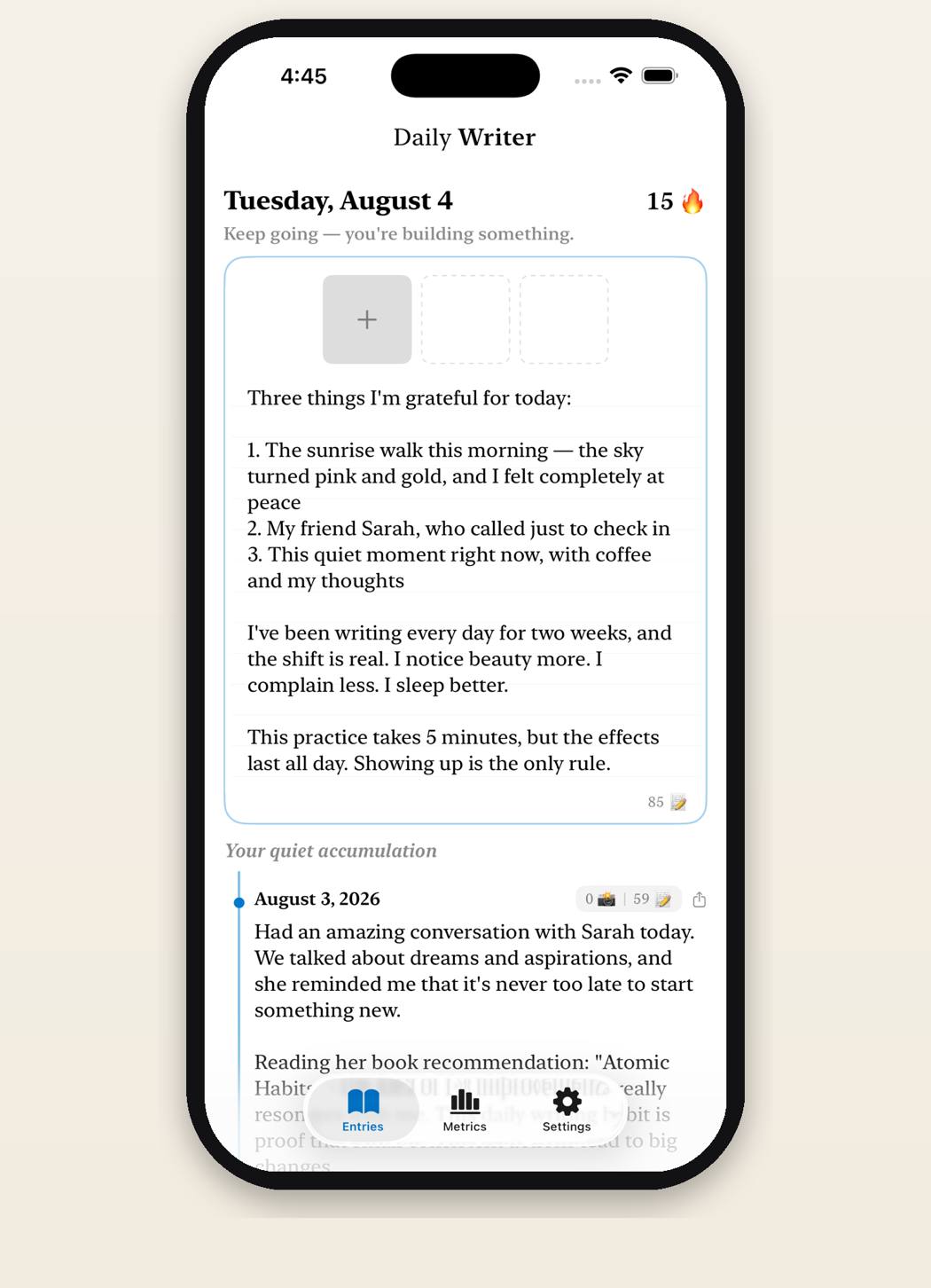
Gratitude journaling collapses when it becomes a list of nouns. Family, health, coffee, repeated for three weeks until it means nothing. The fix is specificity plus a reason: not "my friend" but "Sarah, who called on Tuesday for no reason other than to check in". Naming why makes the item unrepeatable, which is exactly what keeps the practice alive.
Mixing modes in one entry also helps. A short gratitude list at the top, then whatever is actually on your mind underneath, is a more honest shape than either alone. Daily Writer gives you one entry per day with no template imposed on it, so a bullet list, a paragraph and a single sentence can sit in the same day without fighting each other.
Write for the person who reads it in five years
The best filter for what belongs in an entry is a simple one: would a version of you five years from now understand this without your help? That question rules out cryptic shorthand and rules in names, places, prices and dates. It also quietly solves the "is this too boring to write down" worry, because the boring details are the ones that vanish first and are the most startling to find again.
Attach a photo when words are not the right container for the day. Daily Writer allows photos and video alongside the text, which is useful when the entry is really about how a room looked or who was at the table.
And write badly when badly is what is available. An entry that says "too tired, the meeting went fine, the dog is asleep on my foot" is a complete entry. It has a date, it has a fact, it has a dog. In three years it will read better than the polished paragraph you did not write.
Questions
Is it bad to write the same thing every day?
Repetition itself is not the problem. Vagueness is. Writing about the same job or the same relationship every day is normal and often the point, as long as each entry carries at least one detail specific to that day.
Should I use journal prompts or write freely?
Use a prompt only to get moving, then abandon it as soon as something real shows up. Prompts are a way in, and treating them as a form to complete is what makes journaling feel like homework.