How to start a journaling habit that actually sticks

Pick one fixed time, set the daily target absurdly low (100 words, not three pages), and attach the writing to something you already do without thinking. Most journaling habits die in the second week, and they die for the same reason every time: the target was set for the version of you with a free hour, not the version with eleven minutes before the school run.
Build a daily journaling habit, step by step
- Choose the anchor. Attach writing to an action you already perform daily: the first coffee, the train, the two minutes after brushing your teeth. The anchor picks the time so that you never have to.
- Set a target you can hit on a bad day. One hundred words is about one long paragraph and roughly four minutes of typing. Daily Writer fills a progress bar toward a 100-word daily goal, so the finish line is visible from the first sentence.
- Turn on one reminder. A single notification at the anchor time. Three reminders across the day train you to swipe them away, which is the opposite of what you want.
- Write badly on purpose for two weeks. Grammar, structure and deep honesty all cost energy you have not built up yet. Get the appointment established first and let the quality arrive on its own.
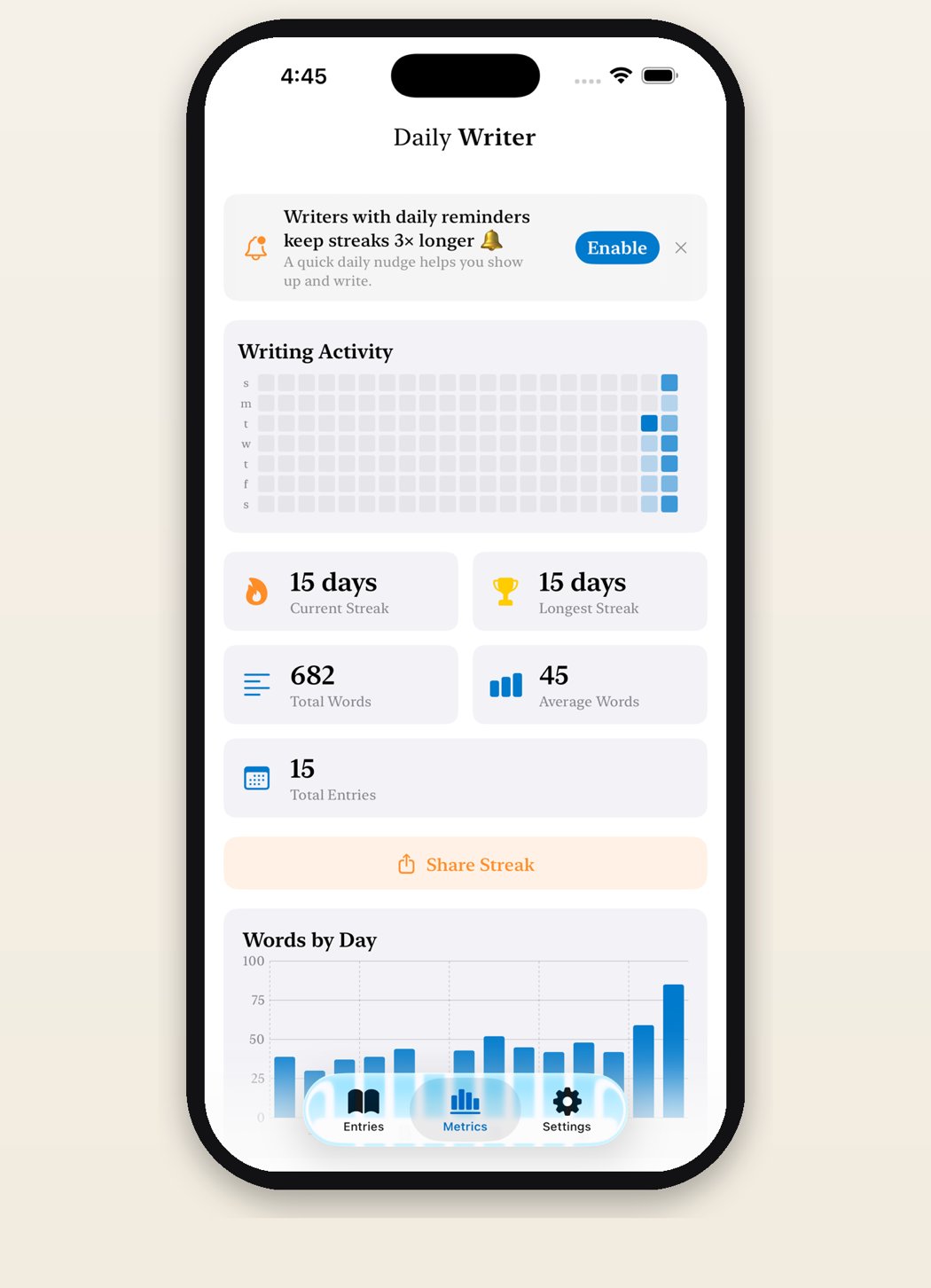
- Watch the streak, not the word count. Fifteen days of 45-word entries beats two days of 900-word entries. The app keeps a current streak, a longest streak and a grid of the days you showed up.
Why most journaling habits die in week two
The usual failure is ambition. Someone reads about morning pages, buys a good notebook, writes 1,200 words on Sunday, 800 on Monday, then nothing after Thursday. The writing was fine. The schedule was fiction. A habit is only as strong as its worst day, and the worst day is a Tuesday in February when you are tired and slightly annoyed at someone.
The second failure is the cluttered blank page. If opening your journal means choosing a notebook, a tag, a mood and a template before a single word, you have added four decisions to the exact moment you have none left. The apps people actually keep are the ones where opening the app and starting to write are the same action.
Set the daily bar low enough to be boring
One hundred words is the whole prescription. That is around four minutes at ordinary typing speed, about the length of two texts to a friend who asked how your week went. Daily Writer uses a 100-word daily goal and fills a bar as you type, which turns a vague intention into a finish line four sentences away.
The counterintuitive part: on ordinary days, stop when you hit the goal even if you could keep going. Ending while you still have something in reserve is what makes tomorrow feel available instead of owed. On the days you genuinely want to keep writing, keep writing. Just do not let those days set the standard for the others.
Track the streak, then stop worshipping it
What keeps people writing on day 40 is rarely the writing itself. It is not wanting to break a number. Daily Writer shows a current streak, a longest streak, a writing-activity grid where every day you wrote turns a filled square, and a words-by-day chart. The grid does the most work: a month of near-solid squares makes a missed Wednesday look like a gap rather than a collapse.
There is a trap on the other side. Once the number gets big enough to feel precious, some people start posting three-word entries to protect it. If you catch yourself doing that, break the streak deliberately and write a real entry. A scoreboard that starts changing the game is broken.
The constraint that makes it permanent
Daily Writer allows one entry per day and seals it at midnight. After that it cannot be edited or deleted. That reads like a limitation until you have lived with it for a month. It removes the whole category of tinkering, of polishing yesterday instead of writing today, and it means the thing you read back in five years is what you actually thought, not a version curated later by a calmer person.
One entry, one target, one reminder. Six weeks of that leaves you with a body of writing you did not have before and a small piece of the day that belongs to nobody else. If you have already failed at journaling twice, the fix is almost never more discipline. It is a smaller daily number.
Questions
How long before journaling feels automatic?
Six to eight weeks for most people, assuming a fixed anchor time and a target small enough to hit on a bad day. The signal is not motivation. It is noticing that you opened the app before you consciously decided to.
What should I do after I miss a day?
Write the next day and say nothing about the gap. The common mistake is a catch-up entry apologising for the missed day, which quietly turns the journal into a place where you owe something.