How to do morning pages
Morning pages are three pages of longhand, stream-of-consciousness writing done first thing after waking, with no editing, no audience and no re-reading. Julia Cameron set the format in The Artist’s Way in 1992. Three pages of A4 by hand comes out at roughly 750 typed words, which is the number to aim for if you are doing this on a keyboard instead.
Do morning pages, step by step
- Write before anything else. Before email, before the news, before the group chat. The point is to catch the mind before the day has told it what to think about.
- Set the length, not the timer. Three handwritten pages, or about 750 typed words. Length keeps you going past the point where you run out of obvious material, which is where the useful part starts.
- Do not stop and do not edit. If nothing comes, write that nothing is coming until something does. Deleting a sentence mid-flow is the single fastest way to end a session early.
- Keep it unread and unshareable. Pages are for clearing, not for keeping. Do not re-read them for at least the first few weeks, and never show them to anyone.
- Repeat daily and expect it to be dull. Most pages are complaints, lists and weather. The occasional page that surfaces something you did not know you thought is what the other twenty-nine are paying for.
The rules, and which of them actually matter
Four rules do the real work: write early, write long, do not edit, do not perform. Everything else in the usual description is a preference. The prohibition on re-reading matters more than people expect, because the moment you know you will re-read something, you start writing for a reader, and the pages stop being a clearing exercise.
The rule most often argued about is longhand. Cameron is firm that pen on paper is slower and therefore less polished, and the slowness is part of the mechanism. That is a real argument. It is also the rule that quietly kills the practice for anyone whose handwriting hurts after a page, or who is doing this on a train, or who cannot read what they wrote a year later.
How many words are three pages?
Around 750. That number is not folklore: the long-running site 750words.com was built specifically as the typed equivalent of Cameron’s three pages, and 750 has been the working conversion for typists ever since. Handwriting on A5 gets you closer to 500, so if you use a smaller notebook, aim at pages rather than word count.
Typing 750 words takes most people 12 to 20 minutes when they are not stopping to think. That is a genuine cost at 6am, and it is worth being honest that a 100-word daily entry and a full set of morning pages are two different practices. If you cannot protect 15 minutes, do the shorter one properly rather than the longer one twice a month.
Morning pages on a phone, done carefully
The phone objection is fair and specific: a phone is the machine that brings you notifications, and opening it first thing is the exact behaviour morning pages are supposed to interrupt. If you write on a phone, put it in Do Not Disturb overnight and open the journal before anything else. Otherwise you will start the session having already read three emails, which is the failure the practice was designed to prevent.
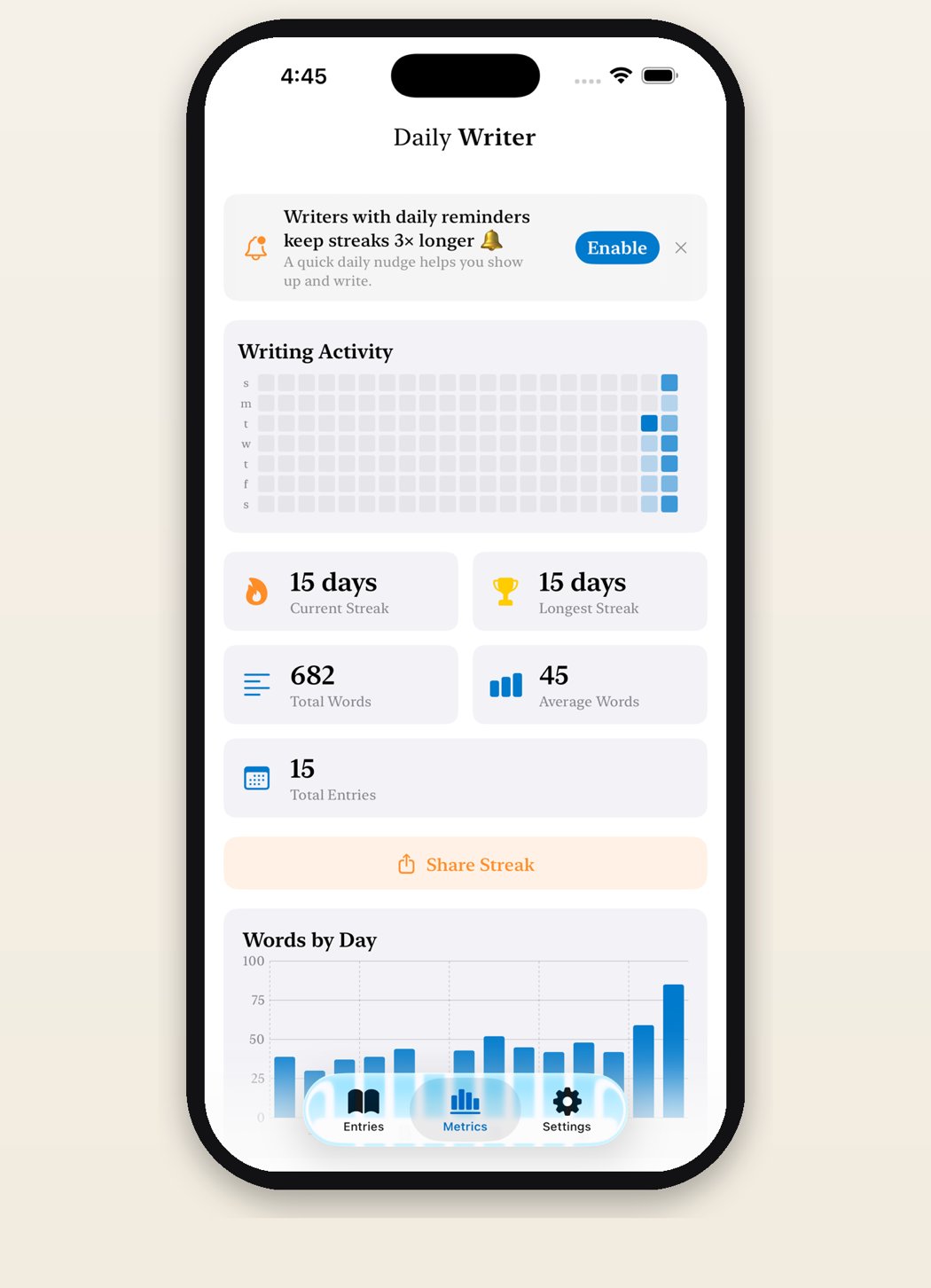
Once past that, a phone has two advantages for this particular practice. Typing is fast enough that you can keep up with an unedited stream, and the words are searchable in a way a shelf of longhand notebooks never is. Daily Writer keeps a words-by-day chart and an average word count, which makes it easy to see whether your "three pages" are actually holding at 750 or quietly drifting down to 300 over a month.
What to do with the pages afterwards
Nothing, mostly. Morning pages are output, not material. The temptation to mine them for ideas or to tidy them into something publishable is the same temptation as re-reading, and it has the same effect on the next morning’s honesty.
This is where a journal that locks entries has an odd advantage over paper. Daily Writer seals each day’s entry at midnight, after which it cannot be edited or deleted, so there is no version of the practice where you go back and improve last Tuesday. Entries stay as written. Free accounts keep the last 100 days available; Prolific Pro removes the limit and syncs across iPhone, iPad and Mac via iCloud.
If a page does produce something you want to keep, copy that one line into today’s entry or a separate note and leave the page alone. The pages are the sweeping. What you carry out of the room is a different object.
Questions
Do morning pages have to be done in the morning?
The early timing is doing real work, since the mind is less organised and less defended before the day starts. Evening pages are still worth writing, but they read more like a report on the day than a clearing of it.
Is typing morning pages cheating?
It breaks Cameron’s longhand rule and keeps the four rules that matter most. Typing is faster and less physical, so you lose some of the friction, and you gain a version of the practice you can sustain on a Tuesday with a sore wrist.