How to stop impulse buying online

Put a delay between wanting something and paying for it, and give the want somewhere to sit while it waits. That is the whole method. When you find something you did not go looking for, save it to a list instead of buying it, then look at the list again after 48 hours. The rule works because it never asks you to say no. It only asks you to say later, which is a decision almost anyone can make at 11pm with a full cart on screen.
Apply the 48-hour rule to online shopping, step by step
- Save instead of closing the tab. The moment you notice the urge, save the product to your list from the share sheet. Closing the tab without saving does not work, because the want comes back and you start the research from scratch, usually with less patience.
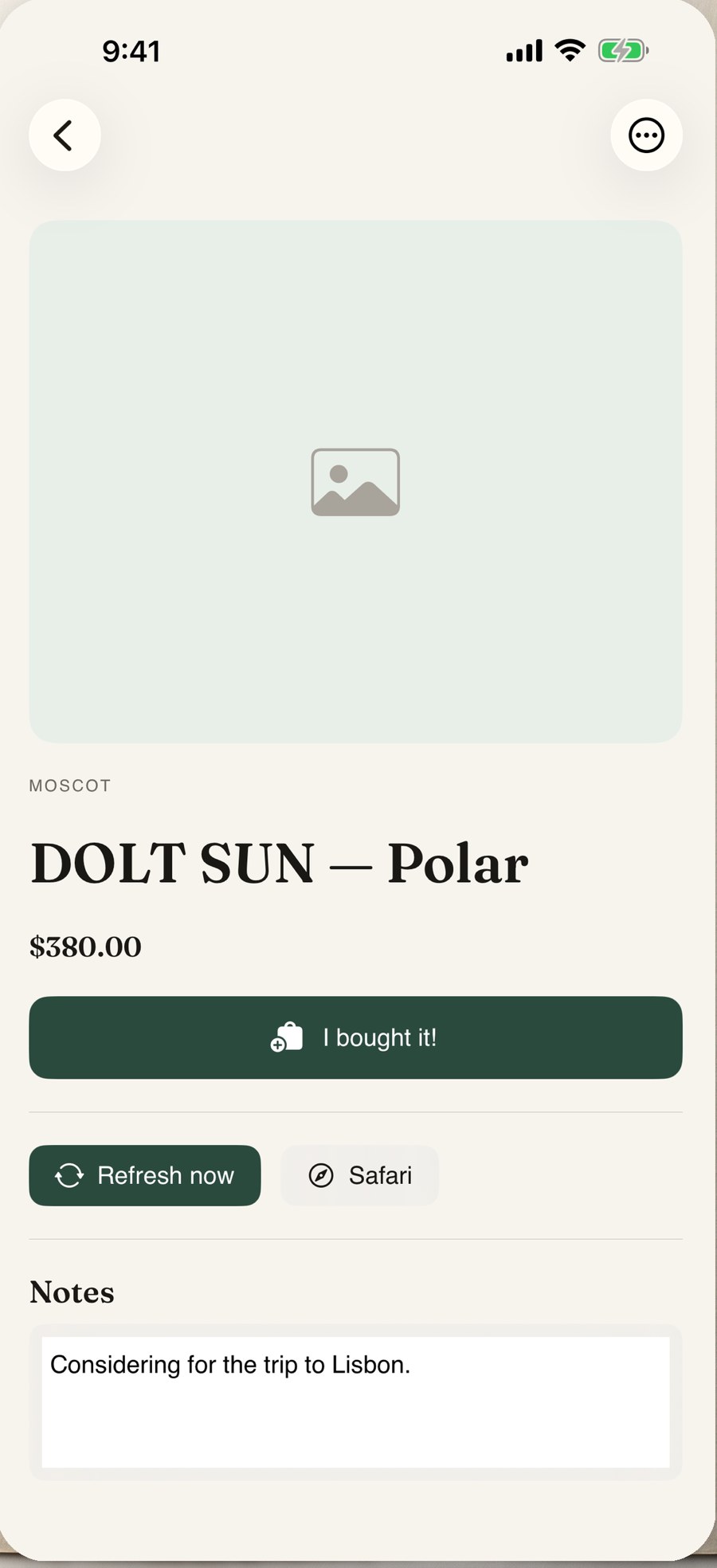
- Write the reason in one line. Notes such as "considering for the trip to Lisbon" or "replacement for the one that broke" take five seconds. In two days that line is what tells you whether the purchase was reasoned or reactive.
- Scale the wait to the price. 24 hours under $50, 48 hours up to a few hundred, a full week above that. Anything you would need to explain to somebody gets the week.
- Look again in the morning. Review the list at a different time of day from when you saved things. Evening wanting and morning wanting are different states, and the gap between them is where the money is.
- Buy it or let it go, then record which. Tap "I bought it!" on the ones you go through with, and archive the rest. After a month you can see your own hit rate, which is more persuasive than any advice.
Willpower is the wrong lever
Online checkout is designed by people whose job is to shorten the distance between an impulse and a completed order. Saved cards, one-tap payment, countdown banners, free returns that make the decision feel reversible. Against that, "be more disciplined" is not a plan, it is a wish.
What does hold up is structural friction that costs you nothing emotionally. Waiting is not refusing, so there is no willpower to run out of. You still get the small hit of acting on the impulse, because saving the item feels like doing something about it. The purchase simply moves to a moment when the store’s design has no hold on you.
Give the want somewhere to go
The reason people abandon the 48-hour rule is that a postponed want with no home just circles back. It becomes an open tab, a reminder, a mental itch. Once the item is on a list with its price and a note about why, the mind lets it go, which is the same mechanism that makes a written to-do list calming.
The list also does something an individual product page never will: it shows you all of it at once. Eight saved items totalling $3,647 is a very different experience from eight separate pages of $298 and $380. That total is the honest version of your want, and it changes decisions on its own.
What to do with the things you never buy
Most saves do not convert, and that is the point. Reviewing an old list is the clearest feedback you can get about your own patterns: the sixth pair of running shoes you did not need, the kitchen gadget that looked essential for one evening. Archive those rather than deleting them, because the pattern is the useful part.
A small list also beats a big one for this purpose. ForLater’s free tier holds ten items, which turns out to be a workable constraint rather than a limitation: adding an eleventh thing means deciding which of the ten no longer belongs. If your considered-purchase list genuinely runs longer than that, Plus lifts the cap at $34.99 a year, which is $2.92 a month against a list that regularly carries four figures of unspent money.
One warning about the method. It works on discretionary buying, not on compulsive spending, which is a different problem with different remedies. If shopping is being used to manage anxiety rather than to acquire objects, a waiting list will not touch the cause.
Questions
Does the 48-hour rule work when the sale ends tomorrow?
Deadline pressure is the exact condition the rule was built for, so keep the wait and accept that you will occasionally miss a discount. In practice the same item is discounted again within a season, and the price you recorded when you saved it tells you whether the next sale is better.
What if I wait the two days and buy it anyway?
Then it was worth buying, and you have a record showing you decided rather than reacted. The rule is not measured by how much it stops. A list where you buy one item in five is working exactly as intended.