How to read the Bible in a year

Reading the Bible in a year means about 3.3 chapters a day, which is roughly 2,100 words and somewhere near ten to fifteen minutes at a normal reading pace. Almost nobody fails because that number is too high. People fail in February, after a missed week turns into a backlog of thirty chapters that feels like homework. So pick any reasonable plan, but decide in advance what you will do with the days you miss, because that decision is what determines whether you reach Revelation.
Read the Bible in a year, step by step
- Set the daily target. Divide 1,189 chapters by the days you will actually read. Reading seven days a week gives 3.3 chapters a day. Reading five days a week gives 4.6, which is still under twenty minutes for most chapters.
- Choose a plan shape. Sequential runs Genesis to Revelation. Parallel reads an Old Testament portion and a New Testament portion each day. Chronological reorders everything by the events described. Parallel plans have the lowest dropout because the New Testament portion keeps arriving during the long stretches of law and prophecy.
- Fix a time and place. Attach the reading to something you already do every day: the first coffee, the commute, the last ten minutes before bed. A habit anchored to an existing routine survives busy weeks far better than one scheduled by intention alone.
- Write the catch-up rule now. Decide the limit before you need it. A workable one is three days: if you are less than three days behind, read double until you are level. If you are further behind than that, start from today and accept a thirteen-month finish.
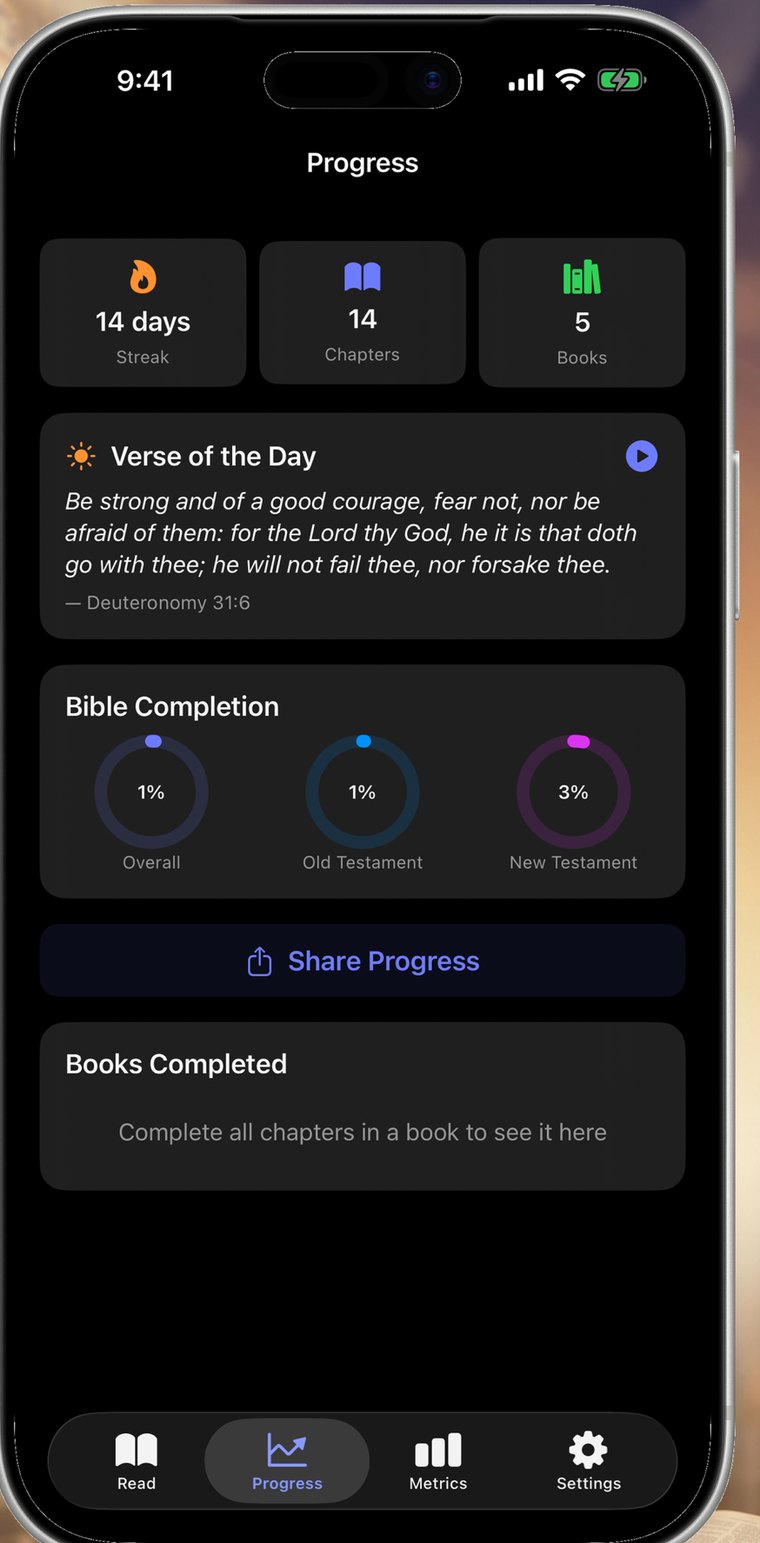
- Track it where you can see it. Keep a visible count of chapters read and days in a row. RSVP Bible tracks the streak, the chapters, and separate completion percentages for the Old and New Testament, so progress is a number rather than a feeling.
The daily budget, honestly
The average day is small. Around 2,100 words takes nine minutes at 240 words per minute and about twelve if you read on the slower side or pause to think. The problem is the average hides the variance. Psalm 119 is 176 verses. Numbers 7 lists the same offering twelve times. Genesis 5 and 1 Chronicles 1 through 9 are genealogies. Those days are two to three times the normal length, and they cluster, which is why plans break in specific places rather than at random.
Knowing where the heavy stretches sit lets you plan around them. Leave a lighter week for the middle of Leviticus. If a day looks long, read the first half in the morning and the rest at night. Splitting a reading is not falling behind.
Which plan shape to pick
A straight sequential read is the simplest to follow and the hardest to survive, because the first fifteen percent of the Bible contains Exodus, Leviticus and Numbers back to back. Many people who quit a yearly plan quit somewhere in those three books, usually in week five or six.
A parallel plan pairs a chapter or two from the Old Testament with one from the New each day. It costs nothing extra in time and changes the texture of every session, so no single stretch of the year is uniformly difficult. A chronological plan reorders the whole Bible by the sequence of events, which clarifies the history and is a good second pass, though the reordering can be disorienting on a first read.
Whichever shape you choose, keep the same one all year. Switching plans mid-stream is the most common form of quietly quitting, because the new plan resets your position and the old progress stops counting.
What to do when you fall behind
Assume you will miss days. Illness, travel, and the ordinary weeks where everything runs late all happen inside a twelve-month commitment. The plans that finish are the ones with a written rule for missed days, and the rule that works is a cap: catch up on a small deficit, forgive a large one.
A backlog of two or three days is worth clearing, because doubling up for a day or two is manageable. A backlog of three weeks is not. Trying to clear it turns reading into a debt repayment, and the reading suffers as much as the schedule. Start again from the current date, finish in thirteen or fourteen months, and count that as having read the Bible. It is.
Building one scheduled catch-up slot into the week ahead of time also helps. If Sunday afternoon is set aside for whatever slipped, four weekday misses in a row never become a crisis.
Make the daily reading harder to skip
Two things keep a streak alive on a bad day. The first is being able to start instantly, without hunting for your place. RSVP Bible reopens at the exact verse you stopped on, with your speed and position preserved, so a session begins in one tap. The second is a floor small enough to be embarrassing to skip: on the worst days, read one chapter and mark the day done. A short reading keeps the chain intact, and an intact chain is what carries you through March.
A fixed reading speed helps too, because it removes the negotiation. At 300 words per minute a three-chapter day is about seven minutes, and seven minutes is a length nobody can argue is unavailable.
Questions
What if I fall two weeks behind a Bible reading plan?
Do not try to read fourteen days of backlog. Resume at the current date and let the plan finish in thirteen or fourteen months instead of twelve. Finishing late is a completed reading; abandoning a plan to clear a backlog is not.
Should my first read through the Bible be chronological?
Usually no. A chronological plan interleaves books and jumps between them, which is illuminating once you know the material and disorienting when you do not. A sequential or Old Testament plus New Testament parallel plan is easier to hold on a first pass.