How to focus while reading the Bible

A wandering mind during Bible reading usually has three fixable causes: the phone within reach, a session longer than your attention span, and a page your eye already knows well enough to skim. Take the phone out of the room, cut the session to ten minutes of real attention, and change how the words arrive so skimming stops being possible. Most people find the third fix does the most work, because familiarity is what makes the eye slide over verses it has read many times before.
Where attention actually leaks
Normal reading is not a smooth sweep. The eye jumps in short hops and doubles back constantly, and roughly one in ten of those movements is a regression to something already read. Some regressions are useful repair work on a difficult sentence. Many are attention drifting and the eye following it, and every one is an opening for a thought about tomorrow to arrive.
Familiar text makes this worse. Psalm 23 and John 3 are so well known that the eye can traverse them while the mind is somewhere else entirely, and you arrive at the end of the passage aware that you read it and unable to say what it said. That is not a spiritual failure. It is what practiced reading does with practiced material.
The phone is the other half. A notification does not need to be read to cost you the thread; the presence of an unread badge is enough to pull a percentage of attention that never comes back to the page.
Fixes that need nothing but a decision
Put the phone in another room rather than face down on the table. Read in the same chair at the same time each day, so the setting itself signals what happens next. Read aloud or under your breath when concentration is poor; the mouth is slower than the eye and it drags attention along with it.
Then shorten the session. Ten focused minutes beat thirty distracted ones, and the ten-minute version is the one you will still be doing in April. Close by writing one sentence about what you read. Knowing a sentence is coming changes how you read the paragraph before it, which is the cheapest attention aid available.
Changing how the words arrive
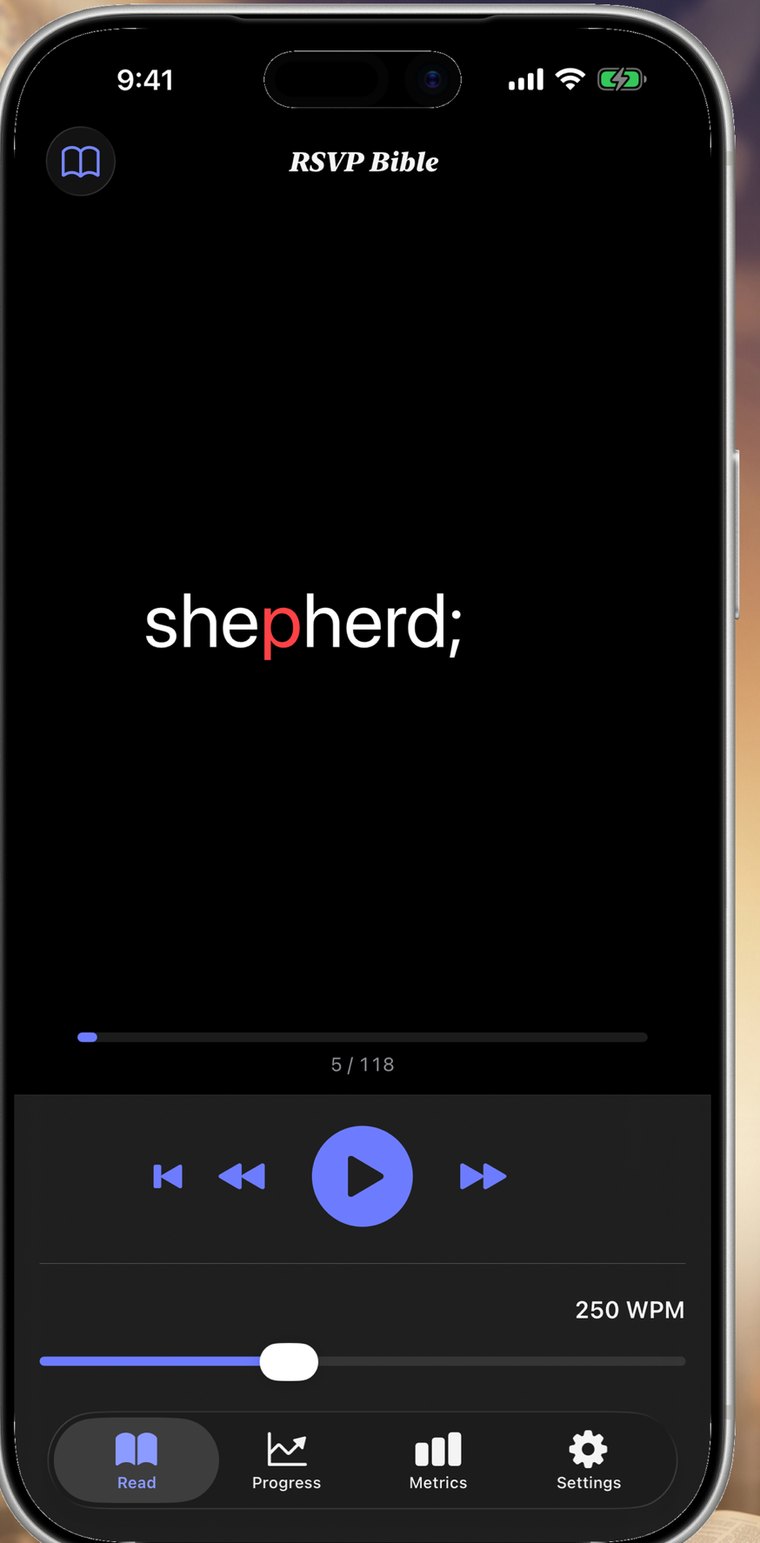
Rapid serial visual presentation, or RSVP, shows one word at a time in a fixed position on screen. Because the words come to you rather than your eye going to them, there is no scanning ahead and no drifting back. Skimming a familiar psalm is not an option when the next word only appears when the previous one leaves, and readers regularly notice detail in passages they thought they knew.
RSVP Bible adds optimal recognition point highlighting, which tints one letter in each word at the position the eye naturally fixates, so recognition happens without repositioning. Its SmartFlow pacing inserts short pauses at the end of sentences and longer ones at chapter breaks, keeping the structure of the text audible even at speed. The pause intensity is adjustable from 1.0x to 3.0x, which matters when you move from narrative in Ruth to argument in Romans.
Speed and comprehension, honestly
Faster is not automatically better. Reading research is clear that comprehension holds over moderate speed increases and then declines at extreme rates, in part because rapid presentation removes the re-reading that helps with hard sentences. Somewhere between 250 and 400 words per minute is where most readers report both sharper attention and full understanding; beyond that the gain is in words covered rather than words absorbed.
Start below your target and let the warm-up mode ramp you up over the first minute. Slow down for dense passages and speed up through narrative and genealogy. If you reach the end of a chapter and cannot summarise it, that is the signal to drop fifty words per minute, not to push on. The point of the pace is attention, and attention is measured by what you carry out of the chapter.
Questions
Does reading the Bible faster mean I retain less?
Not within a moderate range. Comprehension generally holds as speed rises toward roughly 400 words per minute and then falls off past that. The practical test is whether you can summarise the chapter afterwards; if you cannot, reduce the pace.
Is speed reading Scripture disrespectful?
Reading pace and reverence are separate things. Speed reading suits a wide first pass through a narrative book, while slow study, memorisation and meditation on a few verses ask for a different pace entirely. Many readers use both, covering ground quickly and then returning to sit with what stood out.