What is the Bhagavad Gita about?
The Bhagavad Gita is a conversation of roughly 700 verses between the warrior Arjuna and Krishna, his charioteer, held between two armies moments before a battle Arjuna has decided he cannot fight. Arjuna sees relatives and teachers on the opposing side and puts down his bow. What follows across eighteen chapters is Krishna's answer, which widens from the immediate question of whether to fight into how a person should act at all, what endures in a human being, and what different paths of practice have in common. It sits inside the Mahabharata, in the section known as the Bhishma Parva.
The situation the text opens with
The Mahabharata is a long account of a succession dispute between two branches of one family that ends in war. By the point the Gita begins, the armies are drawn up at Kurukshetra and the fighting is about to start. Arjuna asks Krishna to drive his chariot into the space between the two sides so he can see who has come.
What he sees breaks him. The opposing army contains cousins he grew up with, the teacher who trained him, and the elder who raised the family. He argues that victory bought this way is worth nothing, and he sits down. The Gita is the conversation that follows, and it is worth noticing that Arjuna is not passive in it: he keeps pressing, objecting, and asking for something clearer.
How the eighteen chapters are shaped
A common way to describe the structure is three groups of six. The first six chapters concentrate on the self and on action: what a person is, and how to act without being ruled by the results of acting. The middle six turn outward to the nature of the divine and the practice of devotion, and contain Chapter 11, where Arjuna asks to see Krishna's universal form and is undone by it. The last six deal with the qualities of nature that shape temperament, with faith, and with renunciation, closing in Chapter 18 with a long synthesis and Arjuna's answer.
Each chapter carries a name ending in yoga, which here means a discipline or a way of proceeding rather than posture practice: karma yoga for action, jnana yoga for knowledge, bhakti yoga for devotion. Traditions differ, sometimes sharply, on how these paths rank relative to each other, and the text itself is read in several ways on the question. What is not in dispute is that it presents more than one route rather than a single prescribed one.
The ideas that carry the most weight
The line most people meet first is from Chapter 2: you have a claim on your action, but not on its fruits. It is often flattened into advice about detachment, and the fuller point is closer to acting well without letting the outcome dictate whether you act. The next verse adds the other half, that steadiness of mind through success and failure is itself what the text calls yoga.
Alongside that runs a distinction between the enduring self and the changing body, an argument that action performed without grasping does not bind a person the way ordinary action does, and a treatment of the three gunas, the qualities of nature that shape how someone thinks and behaves. Later chapters describe the qualities of a person settled in practice, which reads more like a portrait than a doctrine and is one of the most quoted passages in the text.
Why it is read outside its original setting
The Gita has been commented on continuously for well over a thousand years, by Shankara, Ramanuja, Madhva and many since, and those commentators disagree with each other substantially. It has also travelled far outside India: translated into English from the late eighteenth century onward, it was read closely by Thoreau and Emerson, and Gandhi returned to it throughout his life and wrote his own commentary.
Part of the reason is that the framing question generalises. A person who has to act, who can see harm in every available option, and who would rather not choose, is not a situation confined to a battlefield. Readers arrive at the text for very different reasons and the text has been read as allegory, as philosophy, and as devotional scripture, sometimes by the same reader at different times.
Reading it for yourself
Summaries are useful for orientation and no substitute for the thing, partly because the Gita is short. Eighteen chapters at one a day is under three weeks, and the verses in English come to about 20,000 words, less than a short novel.
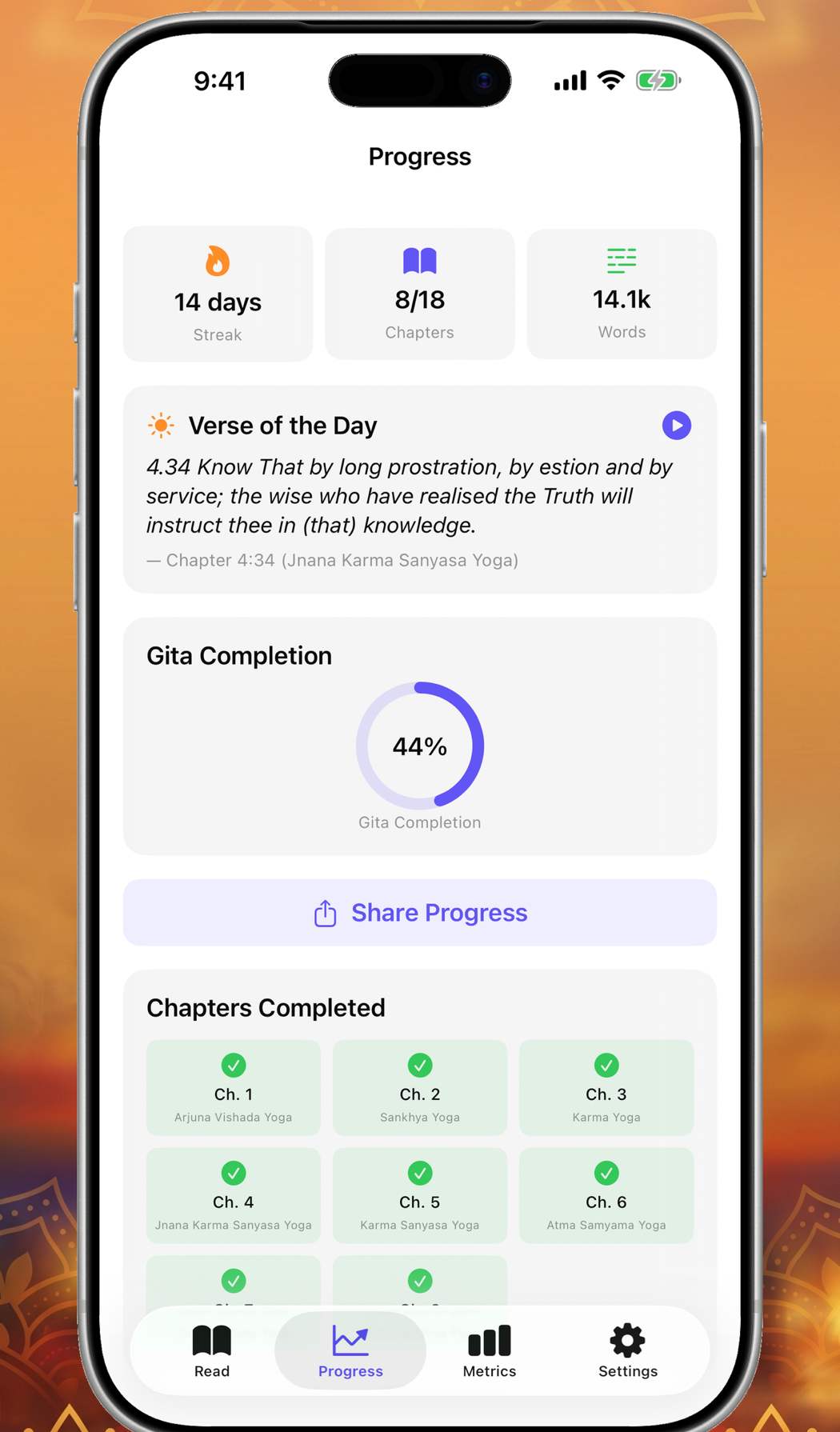
RSVP Gita carries all eighteen chapters with eight translations across Sanskrit, Hindi and English, including the Devanagari original and an IAST transliteration, and presents them one word at a time at a speed you set. It is free to start and the full text is included, so the first chapter costs nothing but the five minutes.
Questions
Where does the Bhagavad Gita appear in the Mahabharata?
It falls within the Bhishma Parva, the section covering the first ten days of the war, and occupies eighteen chapters there. It circulates as a standalone book so widely that many readers never encounter it in its original position.
How old is the Bhagavad Gita?
Scholars generally place its composition somewhere between roughly the fifth and second centuries BCE, with the text likely reaching its present form over a period rather than at one moment. Traditional accounts date it considerably earlier.