Which Bhagavad Gita translation should a beginner read?

For a first read, choose a plain prose English translation with light notes rather than an edition built around extended commentary. The commentary editions are more valuable in the long run and much harder to finish, because a single verse can carry several pages of exposition. A good working plan is one readable translation start to finish, then a second translation on the verses that mattered to you, since translators make different choices for the same Sanskrit terms and the gaps between them are informative.
The three kinds of edition you will run into
Plain translations give you the verses in continuous English with brief footnotes. They read quickly and let the argument stay visible, which is what a first pass needs. Literary translations aim at the Gita as poetry and read beautifully, though they sometimes compress or expand a line for rhythm. Commentary editions pair each verse with a teacher's exposition and are where most serious long-term study happens.
None of these is a better or worse edition in general; they answer different questions. The mismatch that frustrates beginners is picking up a commentary edition expecting a book to read through, or picking up a poetic rendering expecting word-level precision.
How the translators in RSVP Gita differ
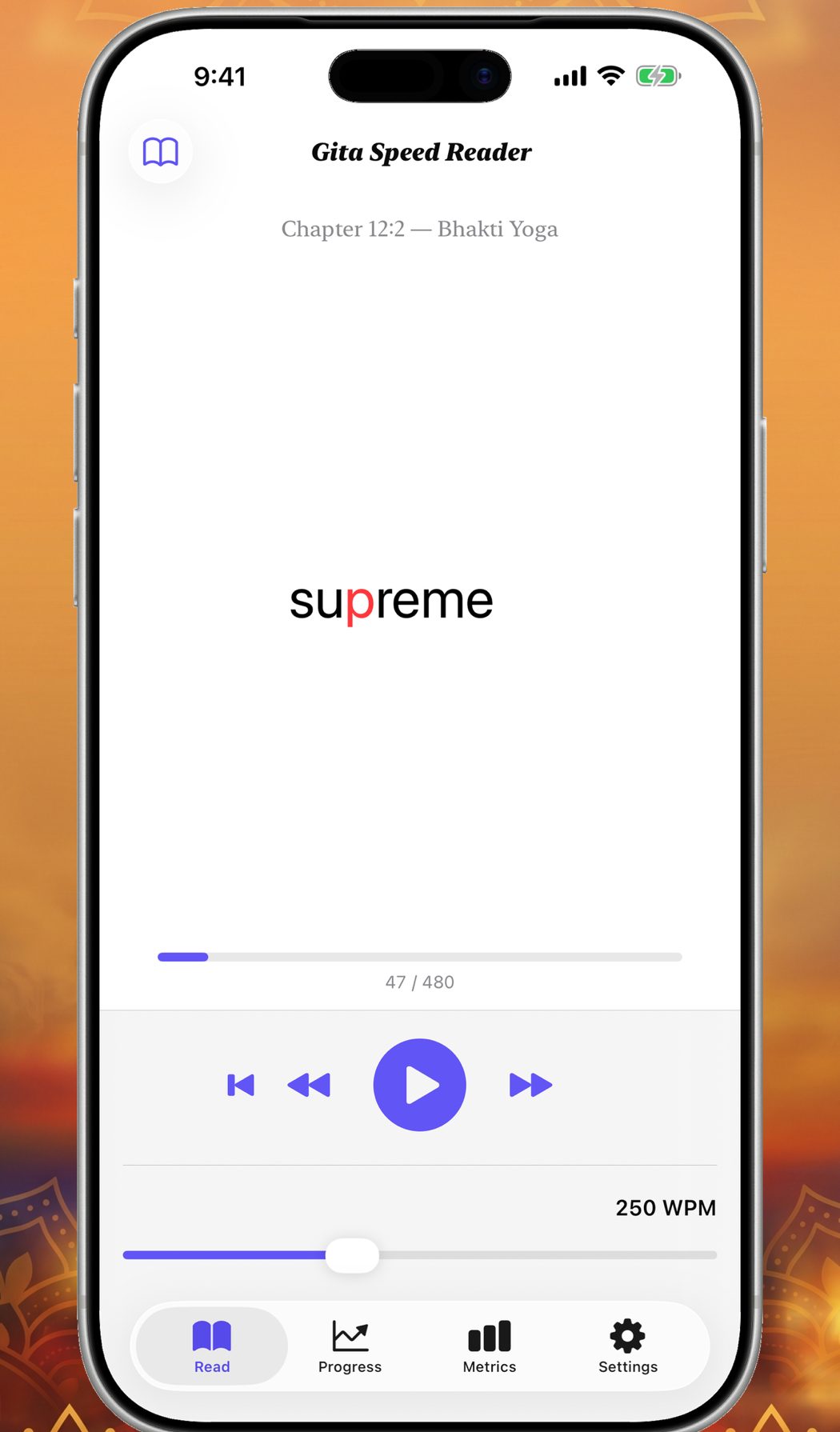
The app carries eight translations across Sanskrit, Hindi and English, which makes the comparison concrete rather than theoretical. Swami Sivananda's English is direct and unadorned, a good default for reading straight through. Shri Purohit Swami's 1935 rendering is more literary and considerably more compressed, so it moves fast but paraphrases where others translate word for word.
Swami Gambirananda's translation comes out of the Advaita Vedanta tradition and follows the Sanskrit closely, which makes it useful when you want to know what a verse actually says before deciding what it means. A.C. Bhaktivedanta Swami Prabhupada's Bhagavad-gita As It Is is the most widely distributed English edition in the world and reads within a devotional Vaishnava framework, with substantial purports in the printed version. On the Hindi side, the app includes Swami Ramsukhdas and Swami Tejomayananda, both widely read in India.
Compare on a few verses, not on reviews
The quickest way to find the voice that suits you is to read the same short passage in three translations and notice which one you actually understand on first reading. Chapter 2 verses 47 and 48 are a good test case: they are famous, short, and translators handle the key terms very differently. Chapter 12 verses 13 to 20, which describe the qualities of a devoted person, are a second useful sample because they are a plain list and differences in style stand out immediately.
Reading them side by side takes about ten minutes and settles the question better than any recommendation, including this one. Having several translations in one app removes the cost of buying three books to run that test.
Where transliteration and Devanagari fit
Sanskrit terms like dharma, karma and yoga carry more range than any single English word covers, which is why one translator writes duty, another writes righteousness, and a third leaves the term untranslated. Once you have read the text in English, seeing the transliteration next to it shows you where the translator made a choice.
RSVP Gita includes the Devanagari original and an IAST Roman transliteration alongside the English and Hindi translations. IAST is worth a few minutes of setup: it uses diacritics to represent Sanskrit sounds unambiguously, so a word looks the same every time rather than varying by publisher. Reading it aloud slowly, at a much lower speed than your English pace, is how most people ease into it.
Questions
Do I need a translation with commentary?
Not for a first read. Commentary is where the text opens up over years, but it multiplies the length of a first pass by five or more, which is why so many first attempts stop in Chapter 2.
Does reading several translations cause confusion?
On a first pass, yes, so stay with one. After that, comparing translations is one of the more useful things a reader without Sanskrit can do, because the differences mark exactly where the original is ambiguous or dense.