How to start reading the Bhagavad Gita

Read Chapter 1 once for the situation, then settle into Chapter 2, which is where the teaching actually begins and where most of the ideas the rest of the text develops are first stated. Pick a single English translation, read one chapter a day, and let the eighteen chapters take about three weeks rather than one long evening. The common way people stall is opening a dense edition with heavy commentary, spending an hour on the first twenty verses, and never coming back.
Start reading the Bhagavad Gita, step by step
- Read Chapter 1 for the setting. Two armies face each other, and Arjuna asks to be driven between them so he can see who he is about to fight. He recognises his own family and teachers on both sides and refuses to raise his bow. That refusal is the question the remaining seventeen chapters answer.
- Slow down for Chapter 2. Chapter 2 is the longest of the eighteen at 72 verses and it introduces most of the vocabulary: the enduring self, action performed without grasping at its result, and the steady mind. If you only ever read one chapter twice, read this one twice.
- Choose one translation and stay with it. Switching editions mid-read makes the same term arrive under three different English words. Pick one voice for the first pass and save the comparisons for a second reading.
- Set a fixed daily slot. One chapter a day finishes the text in eighteen days. Attaching it to something you already do every morning matters more than the length of the session.
- Mark what confuses you and keep moving. Chapters 7 through 12 assume ideas laid down earlier. Note the verse that stopped you, finish the chapter, and come back on the second pass when the vocabulary has settled.
- Read it a second time. The first pass is for the shape of the argument. The second is where individual verses start to mean something, because you already know where the text is heading.
Where beginners usually get stuck
Two failure modes account for most abandoned first attempts. The first is the commentary trap: editions that pair each verse with several pages of exposition are excellent for study and hopeless for a first read, because you finish an hour of reading having covered nine verses and no argument. The second is treating the Gita like a book of quotations, dipping in at random and coming away with disconnected lines that sound wise and connect to nothing.
Both are fixed the same way. Read it as a conversation with a beginning and an end. Arjuna asks a question in Chapter 1, keeps interrupting with follow-up questions all the way through, and says something quite specific at the very end about where he has landed. Reading straight through, at pace, is what makes that arc visible.
Reading a chapter a day without falling behind
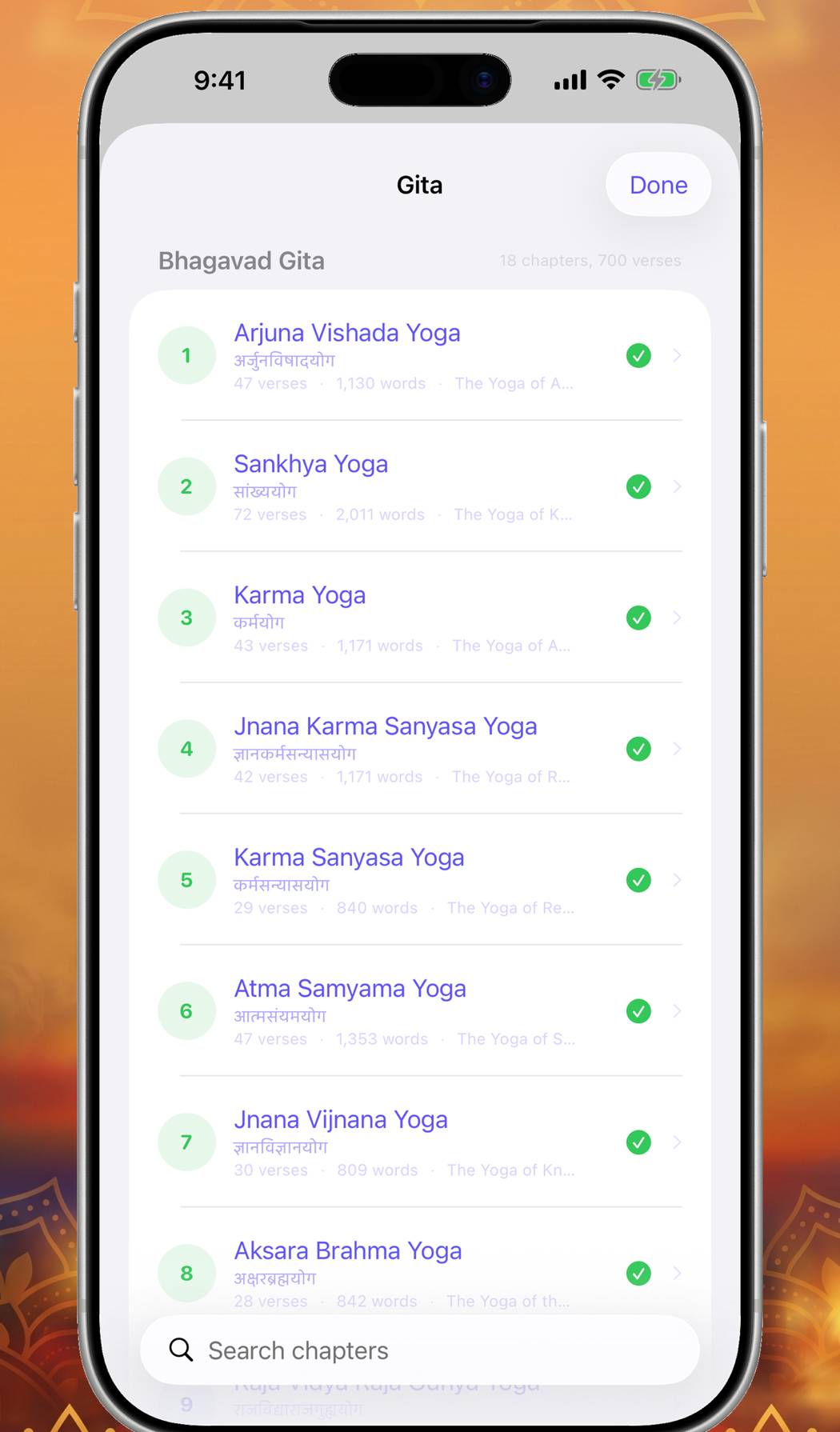
The chapters are uneven. Chapter 2 runs 72 verses, Chapter 18 is the longest at 78, and several in the middle sit around 20 to 30. A daily habit survives that unevenness better than a weekly one, because a short chapter takes only a few minutes and the streak stays intact on a busy day.
RSVP Gita presents one word at a time at a speed you set, which removes the decision about how long a session will take. The chapter list shows the verse count and word count for each of the eighteen chapters before you open it, so you can see that a short chapter is a two minute commitment rather than an unknown. Progress is saved mid-chapter, so an interrupted session resumes on the exact verse.
What to expect from the first read
You will not follow all of it, and that is the normal outcome rather than a sign you chose the wrong edition. The text moves between several lines of argument: how to act, what the self is, what devotion means, and how the qualities of nature shape a person. Chapter 11, where Arjuna asks to see the divine form and is overwhelmed by what he sees, tends to land as vivid whether or not the surrounding philosophy has clicked yet.
Some readers keep a single line per chapter in a notebook. That habit does more for retention than underlining, and after eighteen days you have a page that summarises the text in your own words. It also makes the second pass much faster, because you already know which chapters you owe more attention.
Adding Sanskrit later, if you want it
Plenty of readers never touch the Sanskrit and get a great deal from the text. If you do want it, the sensible sequence is English first, then transliteration alongside the English, then Devanagari. Working in the opposite direction means decoding a script and a philosophy at the same time.
RSVP Gita carries the Devanagari original and an IAST Roman transliteration next to its English and Hindi translations, so switching is a setting rather than a second book. Transliteration reads more slowly than English by a wide margin, which is why the app lets you raise the pause between phrases separately from the reading speed.
Questions
Should I start at Chapter 1 or Chapter 2?
Read Chapter 1, but read it quickly. It sets up Arjuna's refusal to fight and takes only 47 verses. Chapter 2 is where the teaching starts, so that is the chapter worth slowing down for.
Is it acceptable to read the Bhagavad Gita out of order?
For a first read, straight through works better, because later chapters lean on terms defined earlier. Once you have the whole arc, returning to single chapters on their own is how most long-term readers use the text.